7〜8kgのイタグレは大...
イタリアングレーハウンドについてお話ししていると、ときど...
04.Oct.2026

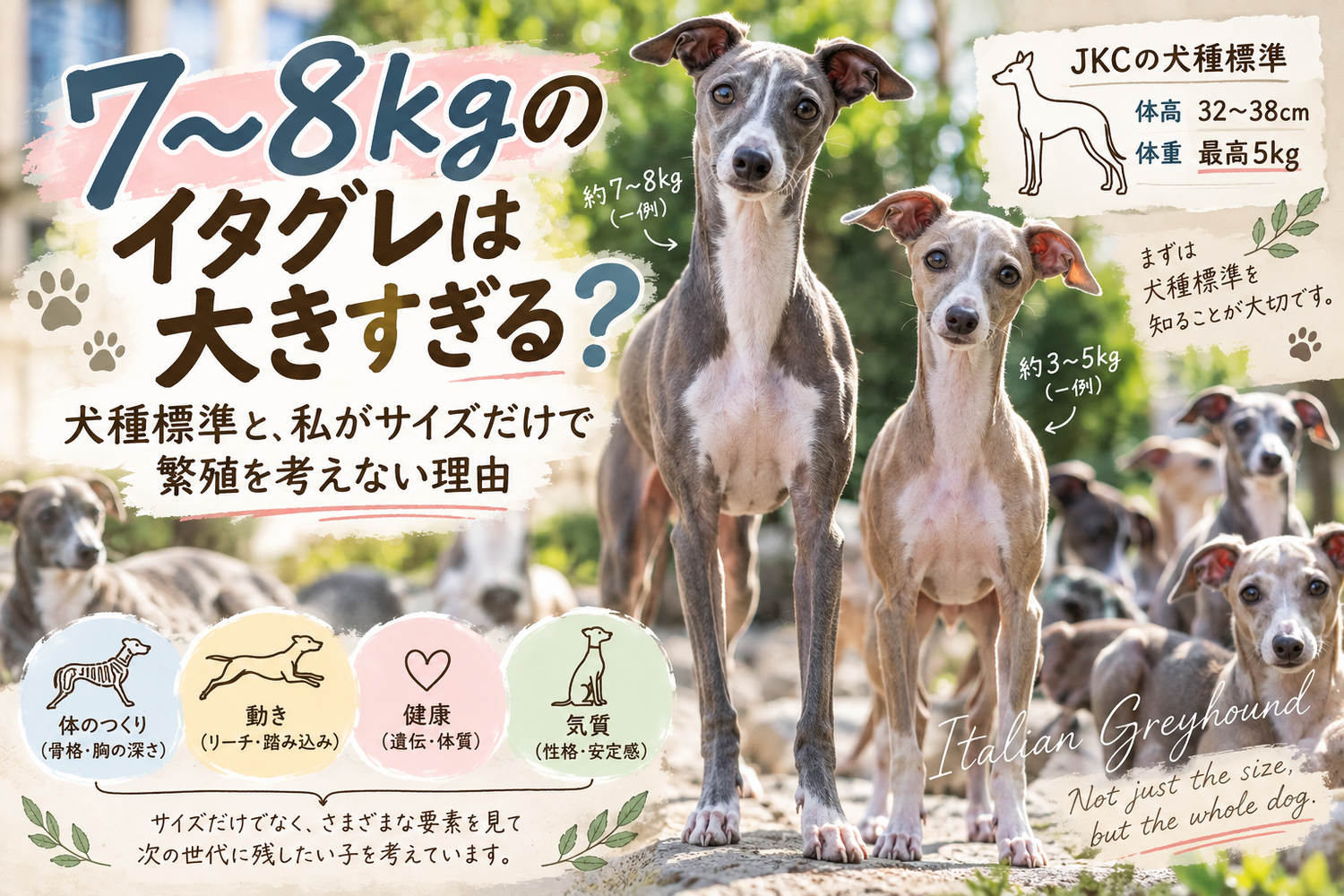
イタリアングレーハウンドについてお話ししていると、ときどき聞かれることがあります。 「7kgや8kgあるイタグレって、大きすぎませんか?」 反対に、 「大きめのイタグレを探しています」 というお問い合わせをいただくこともあります。 実際、イタグレのサイズについては、飼い主さんによって好みがかなり違うように感じます。 では、そもそもイタリアングレーハウンドの正式な犬種標準では、サイズはどのように定められているのでしょうか。 イタグレの犬種標準では何kg? ジャパンケネルクラブ(JKC)が掲載しているイタリアングレーハウンドの犬種標準では、牡・牝ともに体高32〜38cm、体重は最高5kgとされています。 つまり、7kgや8kgのイタグレは、少なくとも体重については犬種標準の範囲を超えています。 ここは、ブリーダーとして曖昧にしたくない部分です。 「大きくても全部イタグレなんだから、スタンダードなんて関係ない」と考えているわけではありません。 犬種を繁殖する以上、その犬種がどのような姿を理想として定められているのか、犬種標準を理解することは大切だと考えています。 ではなぜ、CuddlyAnimalには7〜8kg、あるいはそれ以上になるイタグレがいるのでしょうか。 「大きいイタグレを作りたい」わけではありません 私が繁殖で見ているのは、体重の数字だけではありません。 骨格、胸の深さ、筋肉、身体のバランス、動き、健康状態、気質。 そして、その犬が成長したときにどのような身体になるのか。 いろいろな要素を見ながら、次の世代に残したい犬を考えています。 その結果として、CuddlyAnimalでは一般的にイメージされるイタグレより、やや大きく成長する子が生まれることがあります。 でも、 「大きければ大きいほど良い」 と考えているわけではありません。 同じように、 「小さければ小さいほど良い」 とも考えていません。 私にとって大切なのは、数字だけではなく、その身体をどう作っているかです。 母犬候補を選ぶとき、サイズだけでは決めません 繁殖に残す女の子を考えるときも同じです。 私は、極端に小さいことを理由に母犬候補を選ぶことはありません。 妊娠、出産、授乳は、母犬の身体に大きな負担がかかります。 そのため私は、将来母犬になる可能性のある子を見るとき、単純な体重だけではなく、身体のつくりや骨格、胸郭、健康状態などを見ながら「この子の身体で繁殖を考えられるだろうか」と判断しています。 結果として、身体のしっかりした女の子を残すことが多くなり、それがCuddlyAnimalのイタグレが比較的大きめになる理由のひとつでもあります。 ただし、これは「大きな母犬なら安全」「小さな母犬は危険」という意味ではありません。 出産にはサイズだけでは判断できない多くの要素があります。 あくまで、私が繁殖犬を選ぶときに大切にしている考え方のひとつです。 それなら、小さいオスを交配すればいい? ここで、 「大きめの母犬なら、小さいオスを交配すればちょうどよくなるのでは?」 と思う方もいるかもしれません。 私も交配相手を探すとき、サイズはもちろん見ます。 でも、繁殖はそれだけでは決められません。 小さめで、骨格も良くて、胸の深さもあって、身体のバランスも良くて、動きも良くて、健康面や遺伝的な条件も確認できて、気質も良くて、血統的にも組み合わせられて…… そして欲を言えば、私が好きな顔であってほしい(笑)。 条件を増やしていくほど、候補はどんどん少なくなります。 「小さいオスを掛ければ小さくなる」というほど、ブリーディングは単純ではありません。 親犬それぞれの特徴だけではなく、その後ろに続いている血統まで考えながら組み合わせを考えていきます。 この話は、それだけで一本の記事が書けるくらい奥が深いので、また別の記事で詳しく書きたいと思います。 大きめのイタグレを探している方もいます ブリーダーをしていて意外だったことのひとつが、 「大きめのイタグレを探しています」 という方が思っていた以上にいることでした。 もちろん、小さなイタグレを希望される方もいます。 どちらが正しいという話ではなく、暮らし方や好みによって求めるタイプは違います。 私自身、イタグレがたくさん集まる場所で実際に多くの子を見ると、同じ犬種でも本当にさまざまな体格の子がいると感じます。 だからこそ、私は「イタグレだから○kgでなければならない」という数字だけで、その犬そのものを見ないようにはしたくありません。 ただし、実際に犬種標準が存在することも同時に伝えておきたいと思っています。 犬種標準を知ったうえで、何を残していくのか 繁殖をしていると、ひとつの条件だけを追いかけることの難しさを感じます。 サイズを優先すれば、別の部分で妥協が必要になるかもしれない。 身体の構造を優先すれば、希望していたサイズにならないかもしれない。 理想的だと思った相手でも、血統を確認したら近すぎて交配できないこともあります。 だから私は、 「何kgのイタグレを作るか」 だけを繁殖の目的にはしていません。 犬種標準を知ること。 一頭一頭の身体を見ること。 健康を見ること。 気質を見ること。 そして、その組み合わせから生まれる次の世代を考えること。 その全部を見ながら、繁殖を考えています。 CuddlyAnimalが大切にしているのは、 流行ではなく、10年後の姿を考えて繁殖すること。 小さいから良い。 大きいから良い。 そんな単純な話ではなく、その子が成長し、家族と長い時間を過ごしていく身体だからこそ、サイズという数字だけではなく、その犬全体を見ることを大切にしています。
Version
Is a 7–8 kg Italian Greyhound Too Big? Breed Standards and Why I Don’t Breed for Size Alone
When talking about Italian Greyhounds, I am sometimes asked:
“Isn’t a 7 or 8 kg Italian Greyhound too big?”
At the same time, I also receive inquiries from people specifically looking for a larger Italian Greyhound.
So what does the official breed standard actually say?
According to the breed standard published by the Japan Kennel Club, both male and female Italian Greyhounds should measure 32–38 cm at the withers, with a maximum weight of 5 kg.
Therefore, a 7 or 8 kg Italian Greyhound is above the official standard in terms of weight.
As a breeder, I think it is important to be clear about that.
I do not believe breed standards are irrelevant. When breeding a recognized breed, understanding the characteristics and structure defined by its standard is important.
However, size is not the only thing I consider when making breeding decisions.
I Am Not Trying to Produce Bigger Italian Greyhounds
When evaluating a dog for breeding, I look at many things: bone structure, depth of chest, muscle, overall balance, movement, health, temperament, and how the dog develops as an adult.
As a result of those priorities, some Italian Greyhounds bred at CuddlyAnimal grow larger than what many people expect from the breed.
That does not mean I believe bigger is always better.
And I do not believe smaller is always better either.
For me, the number on the scale is only one part of the dog.
Choosing Future Mothers
The same applies when I consider which females may remain as future breeding dogs.
Pregnancy, birth, and nursing place considerable demands on a mother’s body.
For that reason, I do not select a female for breeding simply because she is very small.
I consider her overall structure, physical development, chest, health, and whether I believe her body is suitable for the demands of breeding.
This means that I often retain physically substantial females, which is one reason some dogs in my breeding program tend to be larger.
This does not mean that a larger female automatically has a safe pregnancy or that a smaller female is automatically unsafe.
Size is only one part of a much larger breeding decision.
Why Not Simply Choose a Smaller Male?
It sounds simple:
“If the female is larger, why not breed her to a smaller male?”
Of course, size is something I consider when choosing a male.
But breeding is never based on one characteristic.
Ideally, I may want a male who is smaller while also having good bone, a deep chest, balanced structure, good movement, appropriate health and genetic testing, a stable temperament, and a pedigree that works with the female.
And, if I am allowed to be a little particular, I would also like him to have a face I love.
The more conditions you add, the fewer candidates remain.
Breeding is not as simple as choosing a small male to produce smaller puppies.
The characteristics of the individual dogs and the generations behind them must also be considered.
That subject deserves an article of its own.
Some Families Specifically Want Larger Italian Greyhounds
One thing that surprised me after becoming a breeder was how many people contacted me specifically because they wanted a larger Italian Greyhound.
Other families prefer smaller dogs.
Neither preference is inherently right or wrong.
Lifestyle and personal preference differ from one family to another, and even within the same breed there can be considerable individual variation.
I have seen many Italian Greyhounds together in real life, and their differences in size and build can be striking.
That experience is one reason I do not want to judge an individual dog only by the number on a scale.
At the same time, I believe breeders should be honest about what the official breed standard says.
Knowing the Standard—and Thinking Beyond a Single Number
Breeding constantly reminds me how difficult it is to prioritize only one characteristic.
If I focus exclusively on size, I may have to compromise somewhere else.
A dog with excellent structure may not be the size I originally hoped for.
And sometimes I find a male I really like, only to discover through the pedigree that he is too closely related to the female.
That is why my breeding goal is not simply to produce Italian Greyhounds of a particular weight.
I consider the breed standard, the individual dog’s structure, health, temperament, pedigree, and what a particular combination may contribute to the next generation.
At CuddlyAnimal, our philosophy is:
We breed not for trends, but with the dog’s life ten years from now in mind.
Small does not automatically mean better.
Large does not automatically mean better.
These dogs will grow, mature, and spend many years with their families.
That is why I believe we should look beyond size alone and consider the whole dog.
Cuddly Animal
住所:茨城県石岡市山崎3745-6